There can never be a better companion than a good pet. Let me show you some tributes from other authors more eloquent than I:

Until one has loved an animal, a part of one’s soul remains unawakened
Anatole France – Writer and Nobel Prize Winner

A house is not a home without a pet
Unknown Author

Animals are such agreeable friends – they ask no questions, they pass no criticisms.
George Eliot – 19th Century English Writer

It often happens that a man is more humanely related to a cat or dog than to any human being.
Henry David Thoreau – 19th Century Author, Poet, and Philosopher

I think dogs are the most amazing creatures; they give unconditional love. For me, they are the role model for being alive.
Gilda Radner – Comedian

He is your friend, your partner, your defender, your dog. You are his life, his love, his leader. He will be yours faithful and true to the last beat of his heart. You owe it to him to be worthy of his devotion.
Author Unknown

Pets are faithful companions, family members just like any human, and in some cases, soul-mates. In a survey by Petfinder.com, about 90% of respondents considered their pet to be an important member of the family. What better companion to bring into your life as you enter retirement. If you live alone, they can be companions that provide unconditional love and acceptance and reduce your loneliness. If you are an empty nester, a dog or cat can fill the void of children who have moved on to their adult lives. If you are an older couple, they can be an additional bond that brings you together.

The benefits of pet ownership have been well documented and in retirement, the benefits can be even greater. Let me list some of these:

Psychological Benefits – Pets Can Make You Happier

In a study published in the Journal of Personality and Social Psychology, researchers looked at variables such as self-esteem, loneliness, illness, and depression. Pet owners did better than non-owners on most measures including less loneliness, greater self-esteem, and better relationships with others. Other research has shown that interactions with pets can reduce stress levels significantly.

Retirement is a time of life when issues related to loneliness and depression can be particularly problematic. These studies suggest that owning a pet can reduce these problems substantially particularly among people living alone.

Health Benefits – Pets Can Make You Healthier

Several health benefits of pet ownership have also been documented. For example, one Australian study found that people with pets had lower blood pressure and reduced cholesterol than people who did not own pets. Both of these are symptomatic of stress. So, this goes hand-in-hand with the psychological benefits. Another study followed heart attack victims and found that pet owners who had had a heart attack had a higher survival rate one year later than those without a pet. Several studies have concluded that pet owners are more physically fit, probably a side benefit of exercising their pets.

Selecting the Perfect Pet for You

The first question you need to ask is what kind of pet you want to adopt. Are you a dog person or a cat person or someone else? As Winston Churchill once quipped: I like pigs. Dogs look up to us. Cats look down on us. Pigs treat us as equals. Dogs and cats definitely have personality differences, but I believe that you can appreciate both.

Most cities with any size have Humane Society shelters as well as others that take in homeless pets. You can find these facilities on-line and then visit the shelter to find an adoption. The only problem I have ever had in one of these shelters is that I find myself wanting to adopt them all, but it is a great experience.

If you are not sure what dog breed would work for you, there are several websites that will allow you to input your personal situation and will recommend the perfect breed. For example, Animal Planet has a website where you answer ten questions about the kinds of characteristics you want in a pet such as size, energy level, your availability to exercise your pet, compatibility with other dogs or cats in the household, etc. Specific breeds are recommended. This breed selector can be found at:

http://animal.discovery.com/breed-selector/dog-breeds.html

Just be aware that they are generally recommending pure breeds and you may be fine with a “mutt.” If you want a pure breed, you will probably need to go on-line to find a breeder specializing in that kind of dog. However, these breed selector websites will help you hone in on the breed that is right for you.

Believe it or not, there are also cat breed selectors as well. Petside.com has a breed selector that allows you to select dogs or cats. Find them at:

http://www.petside.com/breed-selector

Pets provide companionship and unconditional love. For a person entering retirement, finding yourself a four-legged companion may be one of the best things you can do for yourself as well as giving a loving animal a home. Pets provide you both psychological and health benefits and can fill a spot in your life like nothing or nobody else can.

Posted by: drdata921 | June 21, 2013

1000 Mario Andretti’s: Meet My Rush Hour Community

I am going to diverge a bit from my normal, informative retirement topics and talk about something that I will definitely not miss when I retire: the rush-hour commute. Rush-hour is stressful, so I have resorted to humor to try to lower my blood pressure out on the road. See if you recognize any of my “friends” below or perhaps see if you recognize yourself.

For years I have had the opportunity to commute in the not so wonderful, but definitely wacky world of rush-hour traffic. Want to know what a person is really like? Watch them behind the wheel of a car as their normally hidden psychopathologies emerge like Dracula from a coffin.

People who work in marketing use a concept called market segmentation to understand consumers. Segmentation is based on the observation that while people are different, they can be grouped based on underlying similarities. One evening during a particularly grueling commute, it occurred to me that I could create my own segmentation of the drivers around me. See if you recognize these people and their contribution to your rush-hour stress (CRHS).

MEET MY “FREEWAY FRIENDS”

Mario Weaver
These drivers are young, aggressive, and generally male. Mr. Weaver drives at least 20 miles per hour faster than anyone else on the road. These are the true Formula One drivers on the freeway weaving in and out of traffic like Mario Andretti, the famous race car driver. They get their name because on any stretch of highway, they weaver around the traffic and spend time in every single lane. Just say a cheery “good morning Mr. Weaver” as they wiz and weave past you. CRHS: Moderate because you never know when they will misjudge and cause an accident.

Fastlane Freddie
These people thrive on the excitement of the fast-lane. The fast-lane is about speed and risk and the speed limit has little relevance. If you get in front of one of these people and are not going fast enough, defined as virtually any speed you might be going, you should move over or be tailgated into submission. Women are a little more courteous about it than men, but both men and women are included. CRHS: High if you live in the fast-lane, but low for everyone else.

Roger Roadrage
Maybe his behavior is sparked by a personality quirk, or a bad day at work or perhaps a spat with a spouse. But, these drivers are hostile, aggressive, and intensely discourteous. Try to change lanes in front of Roger and he will attempt to cut you off. Make the lane change anyway then the fireworks really begin. They are poised to strike viper-quick with horn-honking, extremely dangerous tailgating and other driving maneuvers, and hand-gestures that I will leave for you to envision. Roger Roadrage sees conspiracy in almost every other driver and is ready to right every affront, real or imagined. CRHS: Very high on those rare occasions.

Sally Slowmo
Sally is the safest of drivers, prudently driving ten miles per hour below the posted speed limit. She is rarely in the fast-lane, but expect her to be travelling the speed limit when she is. I think you can anticipate the reaction of Fastlane Freddie and Roger Roadrage when they are behind her. Sally is very easy to identify. Just look at the car at the head of a slow moving line on the freeway. She is the person who leads other people to do unsafe maneuvers to get around her so she causes a disproportionate number of accidents, but HER driving record is pristine. CRHS: Not stressful, just annoying.

Conrad Convoy
Hail to the truckers on the road. This is a relatively safe group of drivers, but I get nervous as I pass an 18-wheeler. They claim that they can’t see other drivers around them although they have a million mirrors and if they come over into your lane, you have an immediate problem. Even Roger Roadrage is smart enough to avoid a fight with Conrad Convoy. But, get several Conrads on the road at rush-hour and they will spread out laterally across the lanes slowing everyone down. Yes, sometimes they’ve “got themselves a convoy!” CRHS: Generally low.

Don Cruise
OK, this is me making fun of myself. I used to be Fastlane Freddie, but I have toned down with age. I now get onto the freeway and kick in the cruise control. The trick to this in rush-hour traffic is to be going a couple of miles per hour slower than other cars in your lane. If I have to punch out of cruise control because the car in front me can’t maintain speed, I am annoyed. But, generally this has been my coping strategy for reducing my stress-level during a commute and it seems to be working. CRHS: Don’t know and don’t care.

You see, I have come to understand that a lot of the stress during a rush-hour commute is self-inflicted. Travel in the fast-lane and you are asking for stress. Weave in and out of traffic and you have to be extra vigilant or you crash. Sally Slowmo has a stress-free commute because she is clueless. Fastlane Freddie and Roger Roadrage are all about conflict and cause stress in themselves and other. So to reduce the stress of your rush-hour commute be an observer, not an active participant in the antics of the other drivers. Add some fun to your next commute by seeing how many of our characters you can identify among the other drivers around you.

Posted by: drdata921 | June 14, 2013

The Baby Boomers Are Leaving the Building

THE BABY BOOMER REFRAIN: They’re Really Going to Miss Us When We’re Gone

American Business, say goodbye to the Baby Boomer generation as we begin our march into retirement. Yes, you are lightening your payrolls as higher paid workers leave. But, a lot of hard-to-replace knowledge and expertise also is walking out of your door. The generations that follow will be very different from what you have seen. You will not be replacing like with like. You will be getting people with very different mentalities and perspectives on life and career. So, how do the generations differ in the workplace?

THE BOOMER GENERATION (Born 1946 – 1964)

Boomers are distinctly different from the younger generations. Work is a special activity for this group. Many “live to work” versus other generations who “work to live.” Money and title are affirmations of both their accomplishments and their value to the company. However, the paradox is that while they see title and rank as affirmation of their own value, they don’t necessarily respect the title, but rather evaluate the person behind the title. You must earn the respect of a Boomer. Respect is not ascribed by position.

Because of the importance of work to this group, many are described as workaholics and their work ethic is strong. Being part of a team and being a team player is important. Boomers are involved, focused on quality, and are looking for fulfillment – a lot of which is provided by the job. Boomers are driven to accomplish, but don’t micro-manage these people unless you want a very disgruntled worker. Also, don’t ignore their accomplishments or their need to be valued.

GENERATION “X” (Born 1965 – 1980)

Generation “X” is very different in style and perspective compared to Boomers. Let’s start with a very clear difference. Talk to a Boomer about a project or task and they will interpret this as an order that needs to get executed immediately. However Gen “X” will interpret the same conversation as an observation about something that needs to get done, but not necessarily in an immediate time frame. You see, Gen “X” demand the freedom to determine when, how, and where an assigned task is completed. As a group they are very self-reliant, but are open to direction and they do want some structure in the workplace. Having said that, they very much want to do things their way, forget the rules. Providing this freedom is important if you want to retain these workers.

They are very intolerant of bureaucracy which they see as an impediment that gets in the way of their freedom. This group considers the workplace as just a job versus the Boomers focus on “Live to work.” The other important thing is how they respond and are motivated by rewards. For a Boomer, a reward provided at any point is welcome. Not so for Gen “Xers.” For Gen “X” rewards for a job well done must be immediate. Delayed rewards are confusing and do not work as well. As a group, Gen “X” is much more laidback in respect to Boomers. Fun and informality is important. Gen “Xers” are looking for new skills and experiences and will change jobs if their employer does not offer these or if the job gets stale.

GENERATION “Y” (Born 1981 – 2000)

This is the newest generation entering the workforce and man, are they different from what you are used to. This generation grew up with everything electronic and they are wired. Preferred communication channels for this generation are e-mails and instant messaging. This group is comprised of multi-taskers with one hand on a keyboard or I-Pad and the other on a Smartphone.

At work, this group is described as very tenacious, goal-oriented and entrepreneurial. However, unlike the Boomers who “live to work,” Gen “Y” believes that work is just a means to an end, rather than an end in itself. They are motivated by meaningful work, but don’t try to give them tasks that are “make work” or trival, because this will only turn them off. How does this group like to be recognized and rewarded: When they want it and immediately. Delayed rewards do not work. Everything in their world is instant and immediate. They are described as Loyal, technologically savvy, socially responsible, and oriented towards work-life balance.

SO, WHO’S BEST

The reality is, if you are an employer, there is no best. There are only differences. But here’s the point: All of the policies and reward structures that have been in place for so long have been directed to the characteristics of the Boomer generation. As Boomers head for the exits, many of these policies will no longer work and you will need to adapt to the new reality if you want to maintain a happy and productive workplace. “Live to work” is leaving the building!

Posted by: drdata921 | June 7, 2013

Early Retirement?

THE CASE AGAINST EARLY RETIREMENT

What an appealing concept: Early retirement. This is the opportunity to live a more carefree life while you are still relatively young and healthy. This usually means leaving the workforce sometime after age 55, but before age 66. What could be better?

THE STATS

Early retirement in the US is not only common, but the norm. According to a 2012 report issued by the Social Security Administration 71% of men and 76% of women retire before their full Social Security retirement age. Compare this to 1965 when only 21% of men and 49% of women retired before their full retirement age. This trend is clearly accelerating.

Of course some of this is voluntary retirement and some is forced. According to a 2013 survey conducted by Merrill Lynch, 34% of respondents retired early due to poor health and 24% retired following a job loss. So, nearly 60% of early retirees did so under conditions that were arguably involuntary.

On the voluntary side, 27% said that they retired early because they had the financial resources they needed, 16% wanted to spend more time with family, and 10% needed to retire to look after another family member.

So, is early retirement the panacea to a carefree, stress-free, and worry-free life or is that only an illusion?

THE FINANCIAL ISSUES

There are clear financial pitfalls to early retirement. First, the best predictors of how much you have in savings at retirement is how much you contribute monthly and how long you save. Early retirement can lop years off of your savings. Also, if the tendency is for earning to go up with years in the workforce, the amount you save can be reduced as well. So, in the survey mentioned above, 27% had determined that they had the financial resources they needed which leaves a lot of people who might not.

Second, if you file for Social Security benefits before your full retirement age (and age 62 is the earliest), these benefits are reduced. Notwithstanding the fact that you have more years to collect benefits if your retire early, analyses have shown that people who delay filing for Social Security Benefits actually collect a larger total sum, even adjusting for fewer years to collect. The same may be true if you are entitled to pension benefits. Early retirement could mean a smaller income which could force you to downshift your lifestyle.

Finally (and perhaps most obvious), if you retire early, your funds must spread over a longer period of time. So, if you are worried about “running out of money before you run out of life,” early retirement may not work.

In total the issues can be less time to save, a longer time period that your savings must cover, and a lower income being provided by entitlements including a pension if you have one.

THE PSYCHOLOGICAL ISSUES

Are you ready to begin a new life that will be fulfilling? Have you mapped out what that life will be and what you will do on a day-to-day basis? There is a very good question that I ran into on the internet: “Are you retiring from something or are you retiring to something.” We all know how frustrating the working world can be. How many times do you feel that knot in your stomach and the creeping depression on Sunday when you realize that you will need to go to work the next day? I think that this is very common. However, work can provide structure and purpose in your life. So, are you just trying to flee this structure for what you perceive to be more freedom or do you have a new and more exciting life planned out? If it is the former and you have no sense for the latter, you may want to rethink the early retirement decisions. Without forethought, retirement can lead to a boring and unfulfilling existence.

THE PRACTICAL ISSUES

Finally, there are the practical issues. The most obvious of these is healthcare coverage. Affordable healthcare coverage is provided by most employers these day. However, if you are not employed, private coverage can be very expensive. Medicare coverage doesn’t kick in until the month you reach age 65. So, if you retire before then you may be forced to buy health insurance coverage in a very expensive private market. Will your finances be able to handle that additional expense?

WHAT IS THE VERDICT

The idea of early retirement is very appealing on the surface. However, it is not without its pitfalls and is not for everyone. If you decide to explore this option, make sure to do the due diligence of assessing your finances, addressing the psychological issues before you pull the trigger, and making sure that the practical issues of healthcare can be handled adequately.

Posted by: drdata921 | May 31, 2013

Does the 4% Savings Withdrawal Rule Really Work

Is the 4% Retirement Savings Withdrawal Rule a Good Guideline or the Path to Poverty?

Successful people ask better questions, and as a result, they get better answers.

Anthony Robbins, Motivational Speaker

When it comes to retirement finances, we all love guidelines. It makes a complex topic much easier to fathom. In retirement planning, one of the most popular guidelines is the 4% rule originally proposed by William Bengen. This rule states that to maintain a positive savings balance over the course of a retirement, you should start by drawing out 4% of the beginning balance. During each subsequent year, you adjust the previous year’s withdrawal upward for inflation. Mr. Bengen found that given historical inflation rates and investment returns, this would extend savings over a normal retirement. Subsequent research has suggested some changes to the guideline to handle volatility in annual investment returns and inflation. However, the rule remains largely intact and a part of retirement planning folklore.

As I have analyzed my own retirement situation, I have become concerned with the 4% rule. The reason for my concern is not how well it addresses the basic question: “How do I extend my retirement savings over the duration.” Rather it is the important question that it doesn’t address: “If I follow the 4% rule, will I have enough money year-to-year to maintain my standard-of-living.” You see, the first question is focused on extending retirement savings while the second is concerned with maintaining a lifestyle. These are two fundamentally different questions. Don’t get me wrong. Maintaining a positive retirement savings balance is important, but this is only one-half of the financial equation.

I decided to do a deeper dive on this issue. To make this assessment, I used the Retirement Funds Longevity Calculator available in the tools tab. It allowed me to evaluate how long my savings balance would last given application of the 4% withdrawal rule and whether I could meet my annual expense needs. For this example, I made the following assumptions based on averages that I found on-line for 2012: My annual retirement income would be $32,000, I could expect a 5% annual return on my savings, and inflation would average 3.4% (the 50 year average after removing some extreme years in the 1970’s and ‘80’s).

Additionally, I assumed that my beginning retirement saving balance would be $500,000. This is greater than the current baby boomer average of $65,000, but this number varies wildly among pre-retirees. Also, $500,000 is close to the guideline around the income multiples you need in retirement. Finally, at the beginning of retirement I assumed that I will need $50,000 per year to maintain my pre-retirement standard-of-living.

What did I find? In this example if I withdrew the funds I would need to maintain my pre-retirement standard-of-living (disregarding the 4% rule), my savings would last for 26 years before they would be exhausted. If, on the other hand, I followed the 4% rule, my savings would last 31 years, five years longer. However, here is the catch: With a 4% + inflation withdrawal rate I would be able to fully cover my expenses for only the first four years of retirement. After that, I would need to lower my standard-of-living. By my tenth year of retirement, I would have 5% less income each year than I would need. By year 20 this would be 13% less. This shortfall would increase to 19% by year 30. In other words, I would need to reduce my standard-of-living beginning in my fifth year of retirement and this would get progressively worse.

So is it thumbs up or thumbs down for the 4% guideline? In this example, the 4% rule worked as advertised? However, would you be able to cover your expenses for the duration of your retirement? The answer to this question is probably not! To provide a perspective, the average person retiring at age 66 could expect to live to age 84 (males) or 86 (females). So expect income to become an issue early into your retirement if you follow the 4% rule. Run your own numbers to get an answer pertinent to your situation. But, use this discussion as a warning against blind application of the 4% rule.

This is an example of how you can get an answer to the question that you ask. However, it may not be the question that you need answered. What you are really asking is whether you will have enough money for retirement. With the 4% rule, things could get dicey during retirement as you struggle to pay your bills. This harkens back to the age-old question: “Do you want to live well in retirement, or do you want to leave your kids a nice inheritance?”

Posted by: drdata921 | May 24, 2013

Retirement Dreamin’

The question isn’t at what age I want to retire. It’s at what income.

George Foreman, Pro-Boxer and Entrepreneur

Of the topics being discussed on internet retirement websites and blogs the two most prevalent are concerned with retirement finances and retirement timing. Questions about when to retire are frequent, but difficult to answer. The prevailing logic says that “when you FEEL it is time, it is time.” However, this is unsatisfactory advice because it misses some important considerations. If feelings were all that mattered, a large number of people would probably retire in their 30’s or 40’s. This might work for some “internet millionaires,” but is probably impractical for most of the rest of us.

So, I have done the research and worked through this issue in my own case. It seems that the answer to the “when to retire” question is not straightforward. Three factors must come together for retirement to be an option. If you are ready in these three areas, then you are probably ready to pull the trigger on retirement. Here are the questions that you need to ask:

Are You Psychologically Ready for Retirement

Are you psychologically ready for the change to a new lifestyle and set of activities? Note that this is a quite different question from “do I want to change jobs or the company that I work for” which is common among people in the workforce. Are you ready for a life-change that moves beyond questions pertinent to your professional career? For some, retirement can be freedom. For others, it can create a negative situation. If your personal identity is wrapped up in what you do professionally or if you derive a lot of your social relationships from the workplace then retirement may not be for you. Separating yourself from work could cut you off from all of those sources of challenge, accomplishment, and human interaction. On the other hand, if you are ready to move beyond the working world you may be ready for retirement.

If you are unhappy in where you work, but not in what you do then perhaps a job change is in order. Retirement would not correct your current unhappiness. However, if you are looking for a change that will offer more freedom and potentially fewer hassles than your current work-life, perhaps retirement is the right option. This is the first component of the answer to the “when” question.

Are Your Finances Sufficient to Maintain Your Retirement Standard-of-Living

Will you be able to sustain your current standard-of-living if you retire? To answer this question you must assess your sources of retirement income, you expenses, your savings, and any job related income you may plan to collect following your current employment. If the financial picture looks positive, then retirement may be a viable alternative at this point. There are a number of on-line resources and books available to help you determine your retirement financial viability. Search “Retirement Finances” on Amazon.com and you will get an extensive list of books available on the topic. My book (also available on Amazon and in the book tab above) will help you make this assessment as well. Use these resources to help you answer this question. This is factor number two.

Have You Made the Necessary Practical Decisions

Where will you live in retirement? Will you relocate or stay put? If you plan to move, have you worked through the practical aspects of the move? What will you do on a day-to-day basis to keep you busy and engaged once you leave the workforce? Will you find part-time work? Will you pursue volunteer activities? Will you explore new areas of interest? These are all questions that need to be resolved BEFORE you make the retirement decision because they help you define what your new life will be like. There is a lot written on the importance of getting these things settled before you make the leap. This will help you avoid some retirement landmines down the road. To understand this better I would refer you to an excellent book by Ernie Zelinski entitled “How to Retire Happy, Wild, and Free.” Also, you can get a perspective on why preplanning is important in my previous blog post entitled “A Fulfilling Life in Retirement.”

So, What Is the Answer

If there is a confluence among these three areas, then retirement is probably a viable option now. However, typically these three areas do not come together at the same time. Many people are psychologically ready to leave the workforce before their finances make it possible. Or, you may have the money you need, but still derive considerable pleasure from your work. Retirement might not be a positive change.

If, at this point you conclude that these three areas have NOT come together for you, then you need to determine when this will happen. Once you do that, the “when can I retire” question will be answered.

Posted by: drdata921 | May 17, 2013

Retirement Finances & Inflation

INFLATION IS THE BIG CHEST-POUNDING GORILLA IN THE ROOM WHEN IT COMES TO RETIREMENT FINANCES

It’s a little like wrestling a gorilla. You don’t quit when you’re tired – you quit when the gorilla is tired.

Robert Strauss – American Politician & Diplomat

When it comes to retirement financial planning, there are several big gorillas in the room that you must wrestle. But, perhaps one of the biggest is the impact of inflation on your finances. What is problematic about inflation is that year-to-year it looks like a relatively small number. The average inflation rate over the last 50 years has been about 4.0% (3.4% if you exclude some abnormally high years in the 1970’s and 1980’s). It has been only 2.4% over the past 10 years. None of these percentages look particularly high. However, it is the cumulative effect over time that can sneak up on a retiree and play havoc with retirement finances.

Inflation can have two particularly damaging effects on retirement finances. First and perhaps most obvious is that it erodes buying power over time. Each year the cost to maintain your lifestyle edges up. After a 20 or 30 year retirement, these changes can be substantial. The second effect is that the inflation rate has a direct influence on the length of time your retirement savings will last. Let’s take a look at each of these in more detail.

Inflation Erodes Buying Power – BIG TIME

Let’s say, for example, that when you enter retirement you need $50,000 per year to sustain your pre-retirement standard-of-living. Let’s assume also that inflation is at the historic average of 4.0% each year. How does this affect your buying power? After 10 years of retirement, you would need $71,166, a 42% increase in annual income required to maintain your pre-retirement standard-of-living. After 20 years, this would grow to $105,342, an increase of 111% or more than double the beginning income requirement. After 30 years in retirement, your annual income requirement would balloon to $155,933, a whopping 212% increase from where you began. This is more than triple the original requirement. So, what appears to be a small increase from year-to-year can accumulate to a very big number over the course of a retirement.

Inflation Affects How Fast Your Retirement Savings Will Deplete

In retirement, you have sources of monthly income such as Social Security and possibly a pension and earnings from a job. However, whatever expenses are not covered by these sources must be made up by withdrawals from your retirement savings. The rate of inflation will affect what you must withdraw to maintain your standard-of-living. As inflation increases, the amount you will need to withdraw to maintain your standard-of-living increases. What this means is that inflation will have a direct effect on how long your retirement savings will last.

I used the Retirement Funds Longevity Calculator that you can download from the tools tab on this blog to illustrate this point. This calculator allows you to determine how long your savings will last given your retirement income, your savings balance when you enter retirement, the annual investment returns on your saving, and inflation. I assumed, for this example, that you were getting $15,000 per year from Social Security (the average in 2012), an annual pension of $10,000, had $500,000 in savings, and could expect an annualized investment return of 5% on your savings balance. I held those assumptions constant and calculated how many years your savings would last if inflation averaged 1%, 3%, or 5% over the course of a retirement.

How did the inflation rate affect the savings balance? Well, if inflation averaged 1%, your savings would last more than 35 years before the balance reached zero. With a 3% average inflation rate, your savings would be gone in 23 years. However, with a 5% annual inflation rate, your savings would last only 18 years. So, inflation really does have a significant impact on your retirement finances. Note that the exact numbers will vary according to the specific income and savings assumption you use. However, the relative changes are what is important.

To use my primate analogy, what seemed like a baby chimpanzee at the beginning of retirement could become a full-grown, chest-pounding gorilla by the end. There is probably no way to tame the beast. However, you should make sure that inflation is incorporated into your retirement planning and any financial assessments you make. Don’t ignore this. Your retirement financial security depends on it!

NOTE: You are welcome to download the tools in the tools tab above. These will help you assess your own retirement financial situation. The Amazon Kindle book in the book tab above helps you develop your own personal profile and provides detailed instruction on how to use the tools to make your personal retirement financial assessment. The tools are free. The book is a $3.99 investment in your retirement financial success.

Posted by: drdata921 | May 5, 2013

Will the Promises Be Kept – Medicare

In the last post, I discussed the implications of the proposed shift to the “Chained CPI” that would reduce the annual inflation adjustment for Social Security. These proposals were made in the recent Federal budget submitted to congress by the Obama administration. The upshot of that post was that although the changes appear to be minor, over time they could be substantial and cause financial distress for retirees.

In this post I will discuss some of the more visible proposals for Medicare. The proposals in President Obama’s budget would reduce Medicare spending by about $371 billion over 10 years.

To begin with the positive, President Obama proposes to eliminate the prescription drug coverage “donut hole” by 2015. Currently, after the government has paid $2970 in prescription drug benefits, payments end. There are some subsidies that kick in after that point, but they offer only a small partial discount for covered generics. After the recipient has out-of-pocket expenses of $4750 for prescription drugs, they enter “catastrophic coverage” which begins payments again. The donut hole will end altogether in 2015 under the budget proposal. This could be very helpful for the majority of seniors.

Also, the 2% cuts for medical providers that kicked in as part of the “sequestration” process will be reversed. However, cuts for hospitals and some other providers will occur and drug companies will be required to provide greater rebates than they offer now. This could be meaningful for recipients as this potentially could increase the number of physicians who do not take Medicare patients. This could also affect the willingness of hospitals to admit Medicare patients – particularly private hospitals.

On the clearly negative side, there are additional premiums, surcharges, and expenses to shift costs to recipients:

• Beginning for Medicare recipients entering the program in 2017, deductibles for Medicare Part B will increase by $25 until they have increased by a total of $75 in 2021. Part B is that part of Medicare that handles routine doctor’s visits and the like. It is the part where you pay monthly premiums.

• Recipients who buy Medigap coverage that has low cost-sharing requirements will be required to pay a 15% surcharge on top of the cost of their policy which will go to the government. Medigap coverage is the supplemental insurance that protects you from the part of medical expenses not covered by Medicare. The government believes that if insurance is covering the expenses, this encourages excessive use of medical services and the surcharge is designed to discourage that. The government logic may or may not be right, but it does create additional expenses for retirees – however you decide to go.

• The requirement for greater Medicare premiums by “wealthy” retirees is proposed. This would affect singles in 2017 earning more than $85,000 annually or couples earning more than $170,000. While much of this is in place currently, this budget would increase these premiums floors. However, here is the catch: These amounts would not be adjusted annually for inflation until 25% of recipients fall into the limits above. If you fall at the low end of these incomes, your premiums, which cover 25% of the insurance costs now would be increased to cover 40%. At the high end, you could be required to cover as much as 90% of the insurance costs. The larger concern for most retirees should be the lack of an inflation adjustment because it will affect more and more retirees over time. This seems like nothing less than a backdoor attempt to raise Medicare premiums!

To put this in perspective, the Kaiser Family Foundations estimates that if these income criteria were imposed in 2012, the cap for singles would be about $47,000 and about $94,000 for couples. This is hardly what I would define as “wealthy.” I guess that the government defines “wealthy” as anyone who is not direly poor!

So, while there are some good things coming out of the budget, this could be a net cost increase for many if not most seniors. Pair this with reduced benefit adjustments coming from Social Security and you have identified the crux of the problem for retirees.

However, what is most concerning about both the proposed Medicare and Social Security changes is that this is Obama’s opening offer. Anyone who knows anything about negotiation strategies knows that you never open the negotiation with your best offer. So, the final outcome for seniors could be much nastier. The Republicans would clearly like to gut or at least significantly scale back these programs. If the Democrats don’t try to hold the line, who will be the advocates for seniors?

The political perspective is that during the recent election, both political parties said, and I quote: “If you are 55 years old or older or in retirement, you will not see a change.” What happened to that promise? Sounds like election year rhetoric to me! Sounds like we were fed a lie in an attempt to win our votes!

A much more detailed discussion of these changes can be found at:

http://www.thefiscaltimes.com/Articles/2013/04/15/5-Medicare-Changes-Buried-in-Obamas-Budget.aspx#page1

Because of the importance of these issues, please pass on this blog post to others who are in or approaching retirement. If we don’t act to preserve our benefits, the going could get very rough in retirement as adjustments to benefits are scaled back and costs are shifted to retirees.

Posted by: drdata921 | April 26, 2013

Will the Promises Be Kept – Social Security

What Does the “Chained CPI” Social Security Adjustment Really Mean to Seniors

Recently, President Obama submitted a budget to congress that would have clear and relatively quick impacts on the finances of retirees. He included proposals that would affect Social Security benefits. If you are a person in or nearing retirement, what does this mean to you?

In the budget proposal, annual inflation adjustments to Social Security benefits would be reduced. The mechanism is a move to the so-called “Chained CPI” method for calculating inflation. The logic is that the standard method for calculating inflation – the Consumer Price Index or CPI – over-estimates inflation. The rationale for this is that people adjust their purchasing to compensate for higher prices. To give you an example, if the price of beef rises, people will switch to cheaper alternatives (e.g. chicken). Hence, the real rate of inflation is actually less than the CPI estimates and the adjustment to Social Security should be less to reflect this.

Sounds reasonable, right? However, what are the implications? Current estimates say that moving to a chained CPI inflation adjustment for Social Security would shave about 0.25% off of the annual adjustment. If, for example, the CPI estimates inflation at 3%, the Chained CPI would drop it to 2.75%. Social Security checks would be adjusted upward by the 2.75%, not the 3%.

That doesn’t sound like much. However let’s do the math. At the end of a 30 year retirement, assuming an annual 3% inflation rate you would be receiving 6.8% less with the chained CPI. This assumes that you started with the average 2012 Social Security benefit of $1250/month. Over 30 years this would be a cumulative loss of over $28,000 in benefits using the Chained CPI adjustment. Some estimates put that difference as much as 9.4% less or over $38,000 in cumulative benefits lost to the average retiree. This number could be more or less depending on your starting benefit. So, what seems like a minor change can have significant ramifications when you look long-term.

From the government’s perspective this is one way to reduce the deficit. They estimate that over 10 years, savings would be about $341 billion. Of that, $127 billion would come from reductions in Social Security benefits, about $89 billion from other programs ( the social safety net), and $124 billion from tax bracket indexing.

Whoa, hold on for one minute. I understand the cuts to Social Security benefits, but what is this tax bracket indexing thing? Well, the CPI also is used to adjust the Federal Income tax brackets each year for inflation. This protects tax payers from being pushed into higher tax brackets because of inflation. If the Chained CPI adjustment is applied, you get less protection. So, as a senior you potentially could get a double whammy. First, you are collecting less from the Social Security benefit. Second, depending on your income, you could get pushed into a higher income tax bracket.

Now, I understand that the country is in a time of need. However, before you start getting too patriotic let’s do a reality check: Are the assumptions behind the Chained CPI correct?

• First, as prices go up, people shift their purchasing to lower priced alternatives. Nothing wrong with that assumption. This is exactly how consumers react. So, here I am in 2013 and I stop buying expensive beef and shift to cheaper chicken. However, fast forward to 2014 and inflation is up. I have already shifted to the less expensive options, but my Social Security check is under-compensating for inflation. Where do I go now? You see, the Chained CPI logic is very time bound and unless you have options to trade down to cheaper alternatives each year, it is a flawed logic. As a Social Security recipient, you could get into a deeper financial hole each year.

• Second, some economists have argued that the CPI adjustment that is used now, based on costs for urban workers, underestimates the rise in costs for seniors. That is because seniors disproportionately purchase goods and services that have inflation rates higher than the costs estimated by the CPI. An example of this would be health care and health care-related products. So, if the current CPI adjustment is under-compensating seniors for inflation now, a Chained CPI adjustment would only worsen the situation.

The move to a chained CPI may seem a bit technical and of minor consequence until you start running the numbers. Some are predicting a rather alarming rate of poverty among Boomers. These proposed Social Security changes will only make that situation worse. This is something that you need to think about!

Posted by: drdata921 | April 20, 2013

Relocation Possibilities II

RELOCATION – HOW TO GIVE YOUR RETIREMENT FINANCES A BOOST

In my last post, I started the discussion about relocation in retirement. The focus was on resources you could use to find places that fit your priorities such as weather, cost-of-living, recreation, etc. In this blog post, I will discuss the issue of how a relocation decision can affect your retirement finances.

I cover this topic in great detail in my book if you are looking for more (“Do I Have Enough Money to Retire”). In this post I will discuss some of the basics. You may be perfectly happy staying in your current locations when you retire. That is fine! However, a significant portion of retirees prefer a different place. Maybe you want to be closer to family. Perhaps, you have had your fill of brutal midwest winters and want to move to the Sunbelt or the beach. Whatever your personal priorities, this is a discussion that many people have.

Of course, there will be expenses to get to your new home. However, my focus in this blog is on your ongoing financial situation as you consider relocation alternatives. The reality is that relocation can be an alternative that will put you in a better financial situation. Or, potentially it could put further stress on limited retirement resources. How do you figure this out?

This discussion fundamentally is about a comparison of the cost-of-living in the location where you reside prior to retirement compared to alternative locations you might consider. The first order of business, of course, is to develop a shortlist of alternative retirement locations that are of interest to you. Finances are one element of this, but the major priority should be on identifying locations where you truly want to live. There is no benefit in moving to a location that is cheap, but is a place that makes you miserable. Your standard-of-living involves finances, but it also involves your personal quality of life. My last blog post (Relocation Possibilities I) listed resources that can help you figure this out. So, I am assuming that you have done the due diligence before you take on the financial discussion.

Let’s look at how you would determine the financial implications of various relocation decisions. First, we need to make some cost-of-living comparisons. To do this we need to use a cost-of-living calculator. The one that I would recommend can be found on Sperling’s Best Places website:

(http://www.bestplaces.net/col)

While there are a number of cost-of-living calculators on-line, this is one of the better ones because it lets you compare down to the town level (rather than at a large metro level).

I went onto the Best Places website and evaluated several retirement locations that were of interest to me. The inputs required by this calculator are: 1) your current location, 2) the new location you are considering, and 3) your current salary. One trick that I have learned is to use a current salary of $100,000. This will allow you easily to calculate a percent change in the cost-of-living requirement. The table below shows you the results from several comparisons that I made. If I make $100,000 currently, what income would I need to maintain my current standard-of-living in the other locations listed? (NOTE: Click Table to enlarge)

POST4_Table1

These are the numbers that I got from the Best Places website. So for example, if I moved to Pensacola, Florida, I would need slightly more than $84,000 to maintain my current standard-of-living. However, if I moved to San Diego, California, my requirements would balloon to nearly $135,000. The numbers in this table are the incomes you would need BEFORE you retire. OK, so far so good!

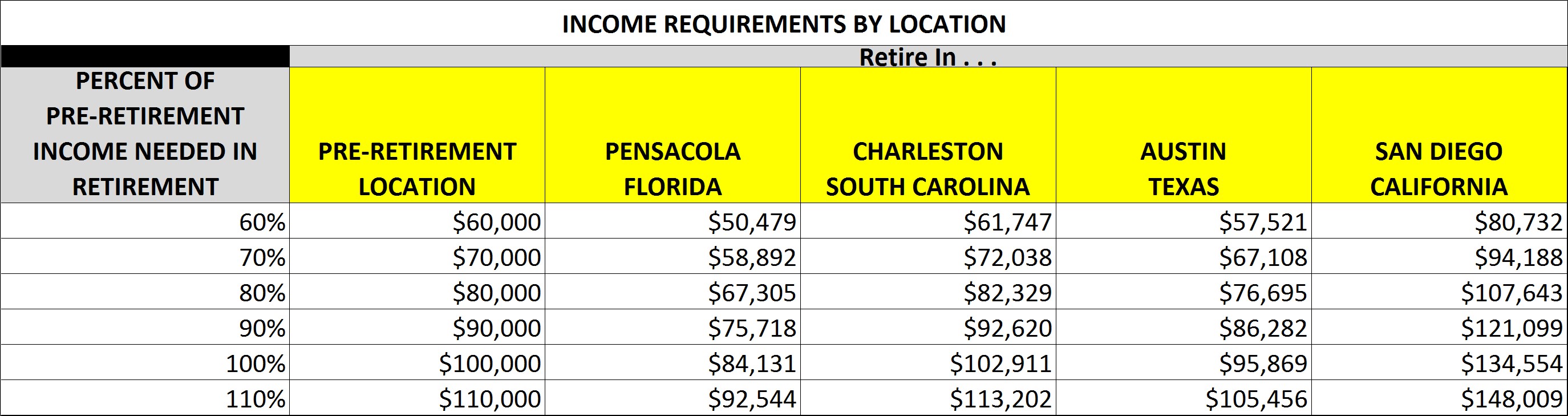
However, in retirement it is a somewhat different story. The reason for this is that your expenses will change and you need to calculate this number. There are a lot of guidelines floating around such a 60%, 70%, 80%, etc. – the percentage of your pre-retirement income that you will need when you retire. You can download a spreadsheet from this blog that will help you figure this out (my book will also help guide you through how you estimate this). But, your retirement expenses are something that you need to determine.

Relocation can factor into this equation. How does this work? Let’s say, for example, that you determine that you need 70% of your pre-retirement income when you retire. But, 70% is based on the cost-of-living in your pre-retirement location. So, let’s say that you are considering relocation to Pensacola, Florida. Your retirement income could get a double boost. You get one boost because you have fewer expenses in retirement (70% of your pre-retirement expenses in this example). The second boost is if you move to a more affordable location. So, taking Pensacola as the example, you would need:

$100,000 (pre-retirement income) x 70% (reduced retirement expenses) x 84.1% (relative cost-of living in Pensacola). If you stay put, you would need $70,000. However, if you moved to Pensacola, you would need only 84.1% of that $70,000 or roughly $58,900. Of course, if you moved to San Diego you would need a little over $94,000 instead of the $70,000 in your pre-retirement location.

As the next table shows, this will vary by the percentage of your pre-retirement income that you need so take some time to figure out what this percentage will be (NOTE: Click Table to enlarge):

POST4_Table2

Relocation is a decision that can take pressure off of your retirement expenses or can add to your headaches. This is definitely something to consider. If you want more detail, see my book. The one clear benefit of this discussion is that you may become depressed by your income needs in retirement until you realize that relocation may be exactly what the doctor ordered.

Retirement finances can be daunting, so look for creative solutions to put you in a better position by “thinking outside of the box.” Relocation can be one of those creative solutions.

Please pass this blog post on to your friends and family and let me hear your perspective on this topic.

« Newer Posts - Older Posts »

Categories